Some sample C# code on how a genetic algorithm can be applied to the linear assignment problem.
This problem can be efficiently solved using the Hungarian algorithm, but I wanted to demonstrate how the genetic algorithm can produce an optimal solution too.
This example is implemented as a simple console application using code developed in Microsoft Visual Studio. To help break down the problem a little, I develop a number of classes for the purposes of encoding potential solutions as chromosomes, maintaining a population of chromosome and applying genetic operators to the population of solutions in the form of crossover, mutation and selection.
Code samples as follows:
Program.cs
The main program loop:
using System;

namespace LinearAssignmentProblem
{
   class Program
   {
      static void Main(string[] args)
      {
         var tasks = 5;
         var popSize = 100;
         var rnd = new Random();

         // Do we seek to maximise or minimise?
         var maximise = false;

         var alg = new Algorithm(rnd, popSize, tasks, maximise);
         var matrix = new CostMatrix(tasks);

         matrix.SetCost(0, 0, 11);
         matrix.SetCost(0, 1, 7);
         matrix.SetCost(0, 2, 10);
         matrix.SetCost(0, 3, 17);
         matrix.SetCost(0, 4, 10);

         matrix.SetCost(1, 0, 13);
         matrix.SetCost(1, 1, 21);
         matrix.SetCost(1, 2, 7);
         matrix.SetCost(1, 3, 11);
         matrix.SetCost(1, 4, 13);

         matrix.SetCost(2, 0, 13);
         matrix.SetCost(2, 1, 13);
         matrix.SetCost(2, 2, 15);
         matrix.SetCost(2, 3, 13);
         matrix.SetCost(2, 4, 14);

         matrix.SetCost(3, 0, 18);
         matrix.SetCost(3, 1, 10);
         matrix.SetCost(3, 2, 13);
         matrix.SetCost(3, 3, 16);
         matrix.SetCost(3, 4, 14);

         matrix.SetCost(4, 0, 12);
         matrix.SetCost(4, 1, 8);
         matrix.SetCost(4, 2, 16);
         matrix.SetCost(4, 3, 19);
         matrix.SetCost(4, 4, 10);

         alg.Run(rnd, matrix, tasks);
      }
   }
}
CostMatrix.cs
Used to maintain the cost of each task for each worker.
using System;
using System.Collections.Generic;

namespace LinearAssignmentProblem
{
   public class CostMatrix
   {
      private int[] _agents;
      private int[,] _costArray;
      private int _n;

      public CostMatrix(int agents)
      {
         _agents = new int[agents];
         _costArray = new int[agents, agents];
         _n = agents;

         for (int i = 0; i < agents; ++i)
         {
            for (int j = 0; j < agents; ++j)
            {
               SetCost(i, j, 0);
            }
         }
      }

      public CostMatrix(int agents, int cost)
      {
         _agents = new int[agents];
         _costArray = new int[agents, agents];
         _n = agents;

         for (int i = 0; i < agents; ++i)
         {
            for (int j = 0; j < agents; ++j)
            {
               int value = cost * (j + 1);
               SetCost(i, j, value);
            }

            cost += 1;
         }
      }

      // Generate cost matrix of arbitrary costs
      public CostMatrix(int agents, int tasks, Random rnd)
      {
         _agents = new int[agents];
         _costArray = new int[agents, agents];
         _n = agents;

         for (int i = 0; i < agents; ++i)
         {
            for (int j = 0; j < tasks; ++j)
            {
               SetCost(i, j, rnd.Next(10, 100));
            }
         }
      }

      public void SetCost(int agent, int task, int cost)
      {
         if (agent < _n && task < _n)
         {
            _costArray[agent, task] = cost;
         }
      }

      public int GetCost(int worker, int task)
      {
         return _costArray[worker, task];
      }

      public int GetChromosomeCost(Chromosome chromosome, bool maximise)
      {
         var totalCost = 0;
         var assignments = new HashSet<int>();

         for (int worker = 0; worker < _n; ++worker)
         {
            var task = chromosome.GetTask(worker);
            assignments.Add(task);
            totalCost += GetCost(worker, task);
         }

         // Penalise cost asccording to constraint violations
         var violations = _n - assignments.Count;

         return maximise ? totalCost - violations * 100 :
            totalCost + violations * 100;
      }
   }
}
Chromosome.cs
Used to encode solutions.
using System;

namespace LinearAssignmentProblem
{
   public class Chromosome
   {
      private int[] _workers;
      private int _cost;
      private int _size;

      public Chromosome(Random rnd, int workers)
      {
         _size = workers;
         _workers = new int[workers];
         Generate(rnd, workers);
      }

      public Chromosome(int workers)
      {
         _size = workers;
         _workers = new int[workers];
      }

      public void Print(int iteration)
      {
         Console.WriteLine("Iteration = " + iteration);
         Console.WriteLine("Total cost = " + _cost);
         for(var i = 0; i < _size; ++i)
         {
            Console.WriteLine("Worker[" + i + "] -> Task[" + _workers[i] + "]");
         }
         Console.WriteLine();
      }

      public Chromosome Crossover(Chromosome chr, Random rnd)
      {
         var child = new Chromosome(_size);

         int index1 = rnd.Next(0, _size);
         int index2 = rnd.Next(0, _size);

         var diff = Math.Abs(index1 - index2);

         while (index1 == index2 || diff + 1 >= _size )
         {
            index2 = rnd.Next(0, _size);
            diff = Math.Abs(index1 - index2);
         }

         if (index2 < index1)
         {
            int tmp = index1;
            index1 = index2;
            index2 = tmp;
         }

         for (int i = 0; i < index1; ++i)
         {
            var task = GetTask(i);
            child.Assign(i, task);
         }

         for (int i = index1; i <= index2; ++i)
         {
            var task = chr.GetTask(i);
            child.Assign(i, task);
         }

         for (int i = index2 + 1; i < _size; ++i)
         {
            var task = GetTask(i);
            child.Assign(i, task);
         }

         return child;
      }

      public void Mutation(Random rnd)
      {
         for (int i = 0; i < _size; ++i)
         {
            if (rnd.Next(0, 100) < 33)
               Assign(i, GetRandomTask(rnd, _size));
         }
      }

      public void Copy(Chromosome chr)
      {
         _cost = chr._cost;
         _size = chr._size;

         for(var i = 0; i < _size; ++i)
         {
            _workers[i] = chr._workers[i];
         }
      }

      public int WorkerCost(int worker)
      {
         return  _workers[worker];
      }

      public int Cost()
      {
         return _cost;
      }

      public int Size()
      {
         return _size;
      }

      public void SetCost(int cost)
      {
         _cost = cost;
      }

      public void Assign(int worker, int task)
      {
         _workers[worker] = task;
      }

      public int GetTask(int worker)
      {
         return _workers[worker];
      }

      public int GetRandomTask(Random rnd, int taskRange)
      {
         return rnd.Next(0, taskRange);
      }

      public void Generate(Random rnd, int taskRange)
      {
         int count = 0;
         foreach (var worker in _workers)
         {
            Assign(count, rnd.Next(0, taskRange));
            count++;
         }
      }
   }
}
Population.cs
Used to maintain a population of solutions.
using System;
using System.Collections.Generic;

namespace LinearAssignmentProblem
{
   public class Population
   {
      private List<Chromosome> _chromosomes;
      private long _bestChromosomeCost;
      private int _bestChromosomeIndex;
      private Chromosome _bestChromosome;
      private bool _maximise;

      public Population(Random rnd, int populationSize, int taskSize, bool maximise=true)
      {
         _bestChromosomeCost = maximise ? -1 : 9999999999;
         _bestChromosomeIndex = -1;
         _chromosomes = new List<Chromosome>(populationSize);
         _maximise = maximise;

         CreateArbitraryPopulation(rnd, populationSize, taskSize);
      }

      public void CreateArbitraryPopulation(Random rnd, int populationSize, int taskSize)
      {
         for(var i = 0; i < populationSize; ++i)
         {
            _chromosomes.Add(new Chromosome(rnd, taskSize));
         }
      }

      public void Evaluate(CostMatrix costMatrix, int iteration)
      {
         for (var i = 0; i < _chromosomes.Count; ++i)
         {
            var cost = costMatrix.GetChromosomeCost(_chromosomes[i], _maximise);
            _chromosomes[i].SetCost(cost);

            if (IsBetter(cost, _bestChromosomeCost))
            {
               _bestChromosomeCost = cost;
               _bestChromosomeIndex = i;
               _chromosomes[_bestChromosomeIndex].Print(iteration);
            }
         }
      }

      public void ApplyCrossover(Random rnd, int taskSize)
      {
         var size = _chromosomes.Count;

         foreach (var chromosome in _chromosomes)
         {
            var prob = rnd.Next(0, 100);

            if (prob < 50)
            {
               var index1 = rnd.Next(0, size);
               var index2 = rnd.Next(0, size);

               while (index1 == index2)
               {
                  index2 = rnd.Next(0, size);
               }

               Crossover(index1, index2, rnd, taskSize);
            }
         }
      }

      public void Crossover(int parentIndex1, int parentIndex2, Random rnd, int taskSize)
      {
         var chr1 = _chromosomes[parentIndex1];
         var chr2 = _chromosomes[parentIndex2];

         var child1 = chr1.Crossover(chr2, rnd);
         var child2 = chr2.Crossover(chr1, rnd);

         _chromosomes[parentIndex1].Copy(child1);
         _chromosomes[parentIndex2].Copy(child2);
      }

      public void Mutate(Random rnd)
      {
         foreach(var chromosome in _chromosomes)
         {
            var prob = rnd.Next(0, 100);

            if (prob < 5)
            {
               chromosome.Mutation(rnd);
            }
         }
      }

      public void StoreBestSolution(int taskSize)
      {
         _bestChromosome = new Chromosome(taskSize);
         _bestChromosome.Copy(_chromosomes[_bestChromosomeIndex]);
      }

      public void SeedBestSolution(Random rnd)
      {
         var index = rnd.Next(0, _chromosomes.Count);

         while (index == _bestChromosomeIndex)
         {
            index = rnd.Next(0, _chromosomes.Count);
         }

         _chromosomes[index].Copy(_bestChromosome);
      }

      public void Selection(Random rnd)
      {
         var size = _chromosomes.Count;

         for (var i = 0; i < size; ++i)
         {
            var prob = rnd.Next(0, 100);

            if (prob < 20)
            {
               var index1 = rnd.Next(0, size);
               var index2 = rnd.Next(0, size);

               while (index1 == index2)
               {
                  index2 = rnd.Next(0, size);
               }

               var cost1 = _chromosomes[index1].Cost();
               var cost2 = _chromosomes[index2].Cost();

               if (IsBetter(cost1, cost2))
               {
                  _chromosomes[index2].Copy(_chromosomes[index1]);
               }
               else
               {
                  _chromosomes[index1].Copy(_chromosomes[index2]);
               }
            }
         }
      }

      private bool IsBetter(long cost1, long cost2)
      {
         return _maximise ? cost1 > cost2 : cost1 < cost2;
      }
   }
}
Algorithm.cs
Used to apply genetic operators.
using System;

namespace LinearAssignmentProblem
{
   public class Algorithm
   {
      private Population _population;


      public Algorithm(Random rnd, int populationSize, int tasks, bool maximise)
      {
         _population = new Population(rnd, populationSize, tasks, maximise);
      }

      public void Run(Random rnd, CostMatrix costMatrix, int tasks)
      {
         var iteration = 1;
         _population.Evaluate(costMatrix, iteration);

         while (iteration < 1000)
         {
            _population.StoreBestSolution(tasks);
            _population.Mutate(rnd);
            _population.ApplyCrossover(rnd, tasks);

            _population.SeedBestSolution(rnd);
            _population.Evaluate(costMatrix, iteration);
            _population.Selection(rnd);

            iteration++;
         }
      }
   }
}
Running the algorithm
As an example I use the same problem as demonstrated by Prof.G.Srinivasan, Department of Management Studies, IIT Madras on his YouTube video, shown at the following link:
https://www.youtube.com/watch?v=BUGIhEecipE

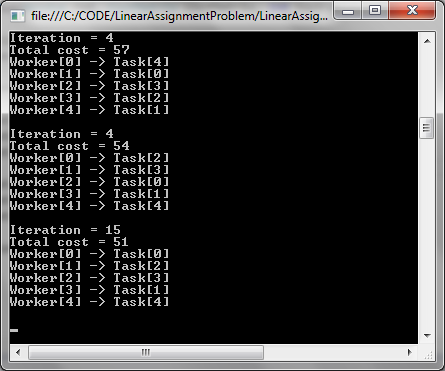
In the example lesson the optimal solution is determined to be 51 by assigning the following tasks:
Worker 1 -> Task 1 = 11 +
Worker 2 -> Task 3 = 7 +
Worker 3 -> Task 4 = 13 +
Worker 4 -> Task 2 = 10 +
Worker 5 -> Task 5 = 10
= 51 total.

This solution is obtained at the 15th iteration of the genetic algorithm as demonstrated by the screenshot below, albeit using zero-based indexing:
Here is a Visual Studio C++ implementation of the Hungarian algorithm available from here:
https://www.technical-recipes.com/Downloads/HungarianAlgorithm.zip