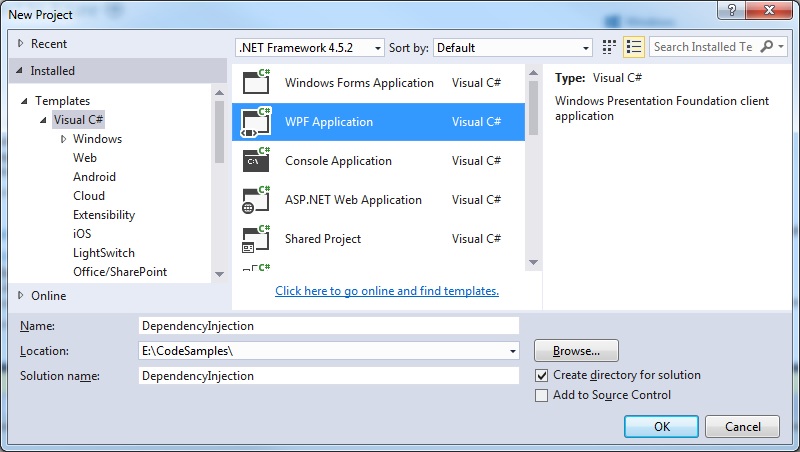
Step 1: Create a new Visual Studio project
Step 2: Add the necessary Unity reference
Select Tools > NuGet Package Manager.
Type in the following command:
Install-Package Unity -Version 4.0.1
Unity website for NuGet can be found here:
https://www.nuget.org/packages/Unity/
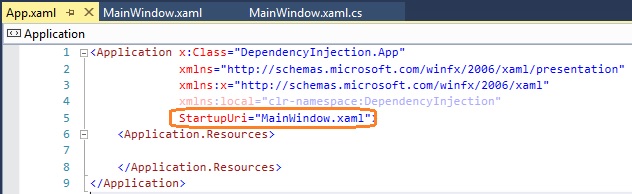
Step 3: Remove the startup URL
In App.xaml get rid of the StartupUri value:
Step 4: Add the Model class / interface
IModel.cs
namespace DependencyInjection
{
   public interface IModel
   {
   }
}
Model.cs
namespace DependencyInjection
{
   public class Model : IModel
   {
      public Model()
      {
         Text = "Hello";
      }

      public string Text { get; set; }
   }
}
Step 5: Add the ViewModel class
To deal with the error that we receive in the XAML when a ViewModel has “No parameterless constructor defined for this object” – be sure to create a parameterless constructor that will call the standard constructor.
MainWindowViewModel.cs
namespace DependencyInjection
{
   public class MainWindowViewModel
   {
      private Model _model;

      public MainWindowViewModel()
      {
      }

      public MainWindowViewModel(Model model)
      {
         _model = model;
      }
   }
}
Step 6: Initialise the View Model on application startup
Here app.xaml.cs is modified as follows:
using System.Windows;
using Microsoft.Practices.Unity;

namespace DependencyInjection
{
   /// <summary>
   ///    Interaction logic for App.xaml
   /// </summary>
   public partial class App : Application
   {
      protected override void OnStartup(StartupEventArgs e)
      {
         base.OnStartup(e);

         IUnityContainer container = new UnityContainer();
         container.RegisterType<IModel, Model>();

         var mainWindowViewModel = container.Resolve<MainWindowViewModel>();
         var window = new MainWindow {DataContext = mainWindowViewModel};
         window.Show();
      }
   }
}
And that is all there is to it.
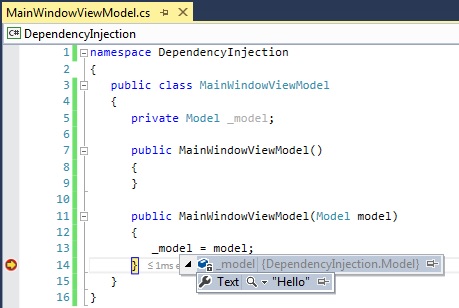
On debugging notice that on startup the ViewModel is dependency injected with the Model: